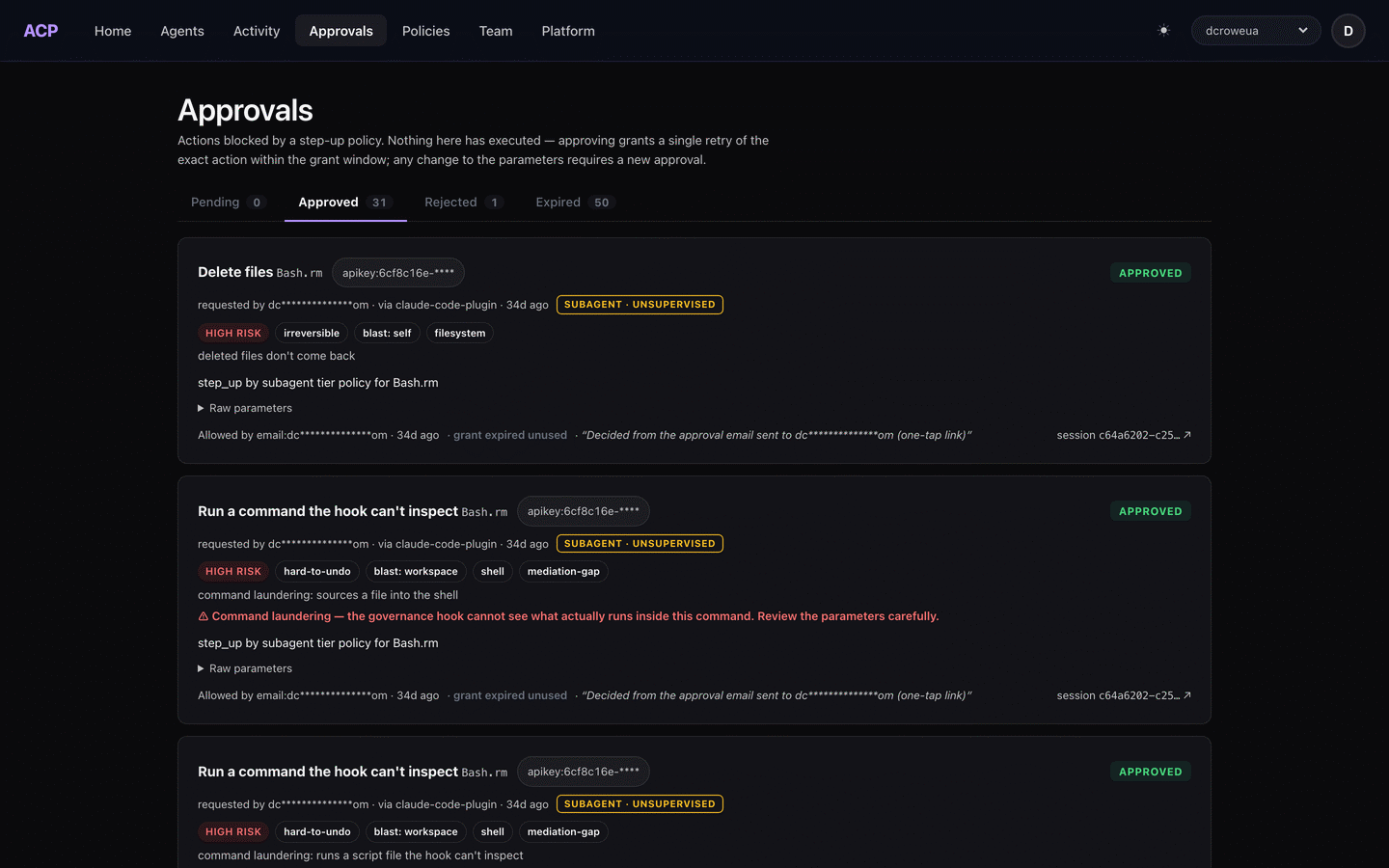
Approvals raised by unattended runs in our own workspace. The tally is honest about the failure mode too: 50 of 82 expired before anyone answered.
Concretely, for `codex exec` in CI or on a schedule: **1. Say what you mean with the sandbox.** The default is read-only; `--sandbox workspace-write` for jobs that edit; `danger-full-access` only inside a container you'd be comfortable losing. (`--full-auto` is deprecated — [details in the hooks reference](/blog/codex-cli-hooks-reference).) **2. Keep enforcement on the synchronous hook path.** Codex keeps PreToolUse firing in sandboxed non-interactive modes, as Claude Code does under `--dangerously-skip-permissions`. A synchronous hook can deny any call, MCP included on current builds, with a reason that goes back to the model as a tool error. That's your gate, and it works with stdin closed. **3. Pre-decide what you would have approved.** This is the step that replaces the prompt. The calls you'd wave through interactively — the read-only MCP tools, the fetch against your own API, `git push` to the PR branch — become allow rules. The ones you'd refuse become denies. The residue you can't classify defaults to deny, and the deny is logged with its reason. A useful source for these rules is your own interactive history: the approvals you've already given, session after session, are the policy you haven't written down yet. (Codex gestures at this itself with `approved_with_amendment`, which persists a one-off approval into a standing prefix rule — the right instinct, one tool wide.) **4. Keep a record you didn't author.** Headless failures are silent by default — a cancelled MCP call and a policy deny look identical in a green-checked CI log. Whatever enforces your rules should also write the per-call record: what was attempted, what was decided, why. When a run behaves oddly, that log is the difference between a diagnosis and a shrug. Steps 2–4 are what our [Codex integration](/integrations/codex) wires up — the hook, server-side rules evaluated per call, and the audit trail — so read the recommendation with that disclosure attached. But the pattern stands without the product: sandbox pinned, hooks synchronous, policy pre-decided, denies loud, record kept. That's a daemon posture you can defend. What it still isn't is a true mid-run approval — a paused call, a human answering from Slack twenty minutes later, the run resuming. Nothing in the Codex ecosystem does that today (#24135 is open precisely because the plumbing doesn't exist), and we'd rather say so than imply otherwise. Deterministic policy covers the large majority of what unattended runs actually need; the async-approval residue is real, small, and worth watching the issue for. ## Frequently asked questions ## Where to read more - [Claude Code headless and approvals](/blog/claude-code-headless-approvals) — the sibling page for Claude Code - [Codex Hooks: The Complete Reference](/blog/codex-cli-hooks-reference) — current hook coverage, deprecations, and the deny contract - [openai/codex#24135](https://github.com/openai/codex/issues/24135) — the canonical issue; watch it for upstream movement - [Which Coding Agents Can You Actually Control, Ranked](/blog/coding-agent-control-surfaces-ranked-2026) — how each agent resolves the headless-ask problem - [Codex CLI scout](https://github.com/agentic-control-plane/acp-governance-sdks/tree/main/examples/framework-scout/codex-cli) — a runnable headless Codex agent with this posture applied