# What Is Runtime Authorization? Definition, Examples, and Why AI Agents Need It
Runtime authorization (run-time authorization) is the permission check that runs at the moment an action is attempted — every call, against live context — instead of once at login. The definition, how it differs from authentication, RBAC and ABAC, what a decision looks like, and where it has to be enforced.
# What is runtime authorization?
Runtime authorization is the permission check that runs at the moment an action is attempted — on every call, against live context — instead of once at login. Each action triggers a fresh decision: who is verifiably calling, which tool with which arguments, what the session has already done, what it has already spent. Deny by default. Every decision logged.
Also written run-time authorization or run time authorization. Same idea under other names: per-call authorization, continuous authorization, runtime policy enforcement. The permission check moves from session start to the action itself.
The short version: authentication happens once and tells you who is calling. Login-time authorization happens once and tells you what that caller's role may do in general. Runtime authorization happens every time and tells you whether *this* action may happen *now*. For a person clicking through an app the three blur together. For an AI agent making forty tool calls a minute, only the third one describes what actually ran.
---
## Runtime authorization, defined
A runtime authorization decision has four parts, and a system only qualifies if it has all four:
1. **It runs per action.** Not at login, not per session — on every call that could change something.
2. **It sees live context.** The verified identity, the exact tool and arguments, the calls that came before, and cumulative use (requests, spend, delegation depth). A role name alone is not context.
3. **It is enforced where the caller can't skip it.** The decision sits on the path between the caller and the thing being called. A check the caller is trusted to perform on itself is a suggestion.
4. **It leaves a record.** Each decision — allow, deny, or hold for a person — is written with the rule that produced it.
Drop any one and you have something else: a login-time grant (no per-action check), an allowlist (no context), a system-prompt rule (no enforcement), or a firewall with no logs (no record).
---
## Runtime authorization vs. authentication
These get conflated because both are "auth." They answer different questions at different times.
| | Authentication | Runtime authorization |
|---|---|---|
| **Question** | Who is calling? | May this action happen, right now? |
| **When** | Once, at the start | On every action |
| **Input** | Credentials, tokens | Verified identity **plus** the call, its arguments, prior actions, cumulative use |
| **Output** | An identity | A decision and a reason |
Runtime authorization depends on authentication — the identity it checks has to be verified, not claimed. It does not replace it.
---
## Runtime authorization vs. login-time authorization (RBAC)
Traditional authorization was designed around a human session: authenticate once, receive a role, and the role's grants hold until logout. That model works when the thing exercising the permissions is a person, because people are slow and deliberate — one click at a time, each action reviewed by the person taking it.
| | Login-time (classic RBAC) | Runtime authorization |
|---|---|---|
| **When policy runs** | Once, at session start | On every action |
| **Question answered** | "What can this role do?" | "May this action happen, right now?" |
| **Context available** | Role, group, tenant | Identity **plus** the specific call, its arguments, prior actions, cumulative spend, delegation depth |
| **Default posture** | Grant the role's full surface | Deny by default, allow explicitly |
| **Sees action chains** | No — each grant is evaluated in isolation | Yes — read-then-exfiltrate looks different from read |
| **Audit granularity** | Session-level | Per action, with the matched rule |
RBAC doesn't disappear in this model. It still defines the baseline — who is allowed what, in principle. Runtime authorization is the layer that checks each actual action against that baseline, plus the context RBAC can't see.
---
## Runtime authorization vs. ABAC
ABAC (attribute-based access control) is a *policy model*: decisions from attributes of the subject, the resource, and the environment. Runtime authorization is about *when and where* the decision runs — every call, at a point the caller can't bypass. The two compose: a runtime authorization layer usually evaluates ABAC-style policy, and it adds an attribute ABAC on its own rarely has, which is the session's own history.
---
## How runtime authorization works: the decision loop
Every call carries its context to the policy point. The policy point returns a decision and a reason, and writes the audit row:
```yaml
# input — assembled by the enforcement point, not the agent
identity: auth0|8f3a2b1c # verified JWT, not a claim the agent makes
tool: email.send.external
agent_tier: background # no human watching this session
chain: depth 2, root auth0|8f3a2b1c
spend: $48.73 of $50.00 daily budget
# output
decision: DENY
reason: role:rep denied tool:email:send:external
audit: written (identity, tool, rule, timestamp)
```
Three outcomes are possible: **allow**, **deny**, or **ask** — hold the call until a person answers. The decision is boring by design. What matters is that it runs on *every* call, and that the caller finds out the way any client finds out — a denied request with a reason — rather than being trusted to check policy itself.
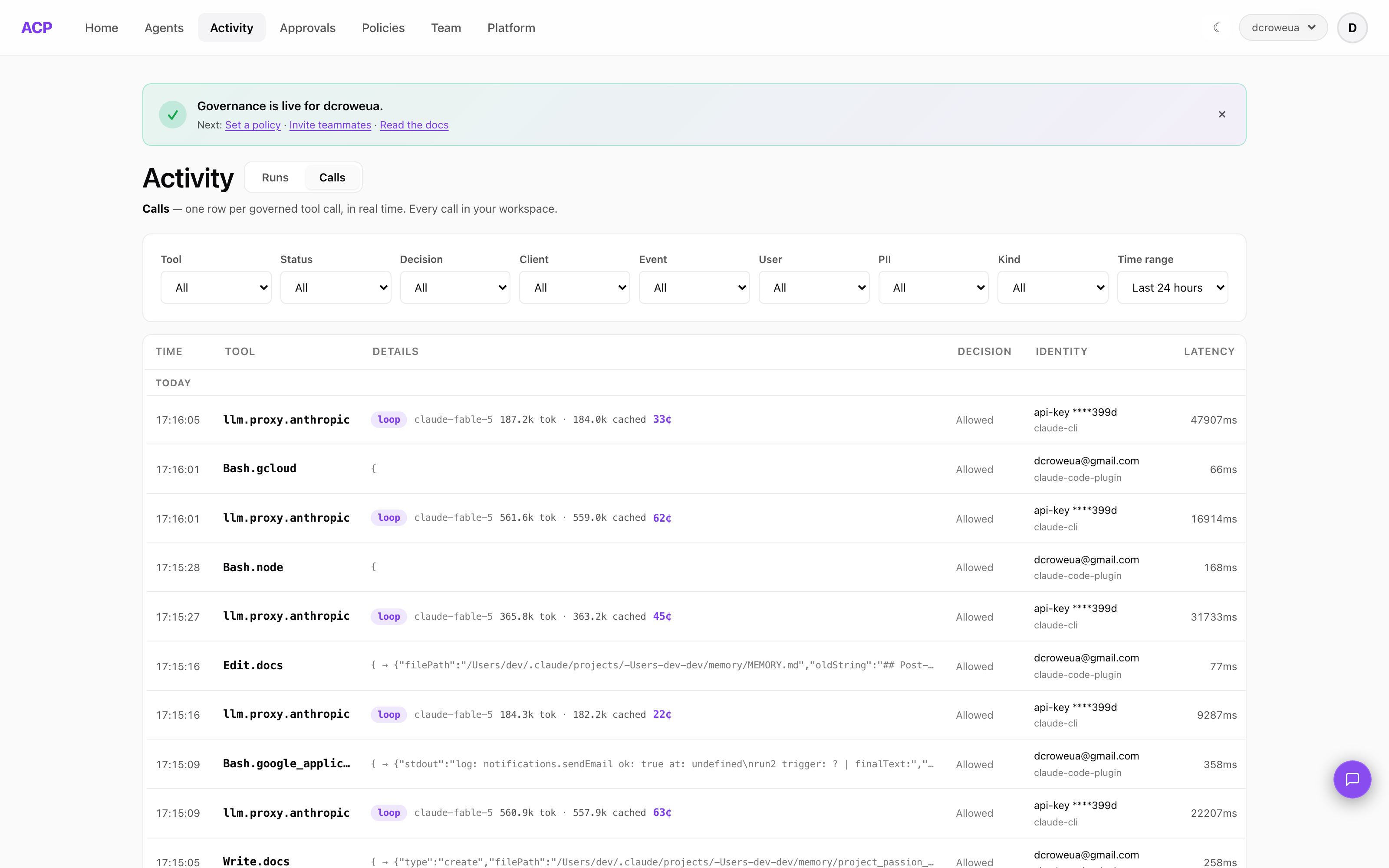
Here is that loop live: one row per policy-checked tool call, with the decision, the verified identity behind it, and the latency of the check.
Runtime authorization in practice: every tool call is one row — decision, identity, latency. Real workspace, live traffic, policy checks running in tens of milliseconds.
---
## Runtime authorization examples
Concrete rules, each of which only works if the check runs per call:
- **Tool by tier.** `Bash.rm` is allowed in an interactive session, held for a person when a subagent asks, denied for a background job. Same tool, three answers, decided by who is watching.
- **Chains.** Reading CRM records is allowed. Reading CRM records and then calling `email.send.external` in the same session is denied — the second call is judged with the first in view.
- **Spend as permission.** "May consume $50 of model calls today" is a policy statement. Call 412 is denied because calls 1–411 already spent $49.90.
- **Delegation.** An agent acting for a manager gets a narrowed scope, not the manager's scope. RFC 8693 (OAuth token exchange) exists because delegated access is supposed to shrink.
- **Argument-level checks.** `git push` is fine; `git push --force` to `main` is held. The tool name alone can't tell them apart; the arguments can.
---
## Why AI agents force the issue
Runtime authorization existed before AI agents — zero-trust architectures have argued for continuous verification for years. Agents made it non-optional.
An agent given a task chains tool calls autonomously: it decides *while running* which files to read, which commands to execute, which APIs to hit. It operates at machine speed — dozens of calls per minute — and each call is an action your login-time grant never specifically approved. By the time a human could review the third call, the agent has finished the task.
That gap has a precise shape:
- **You authorized intent, not actions.** "The agent may act as Alice" says nothing about *this* `DELETE` statement at *this* moment.
- **Risk lives in chains, not calls.** Reading CRM data is fine. Reading CRM data then calling `email:send:external` is an exfiltration pattern. Only a per-call layer that has seen the earlier calls can tell the difference.
- **Delegation shouldn't mean inheritance.** An autonomous process acting for the CFO should not hold CFO-level permissions. Most agent frameworks skip narrowing entirely; OWASP's Top 10 for Agentic AI names the result — excessive agency — as a headline risk.
- **Spend is an authorization question too.** A [single looping agent can spend a month's budget overnight](/blog/runtime-authorization-for-ai-agents#budget-as-authorization) if nothing meters it per call.
---
## Where runtime authorization is enforced
Where the check runs matters as much as what it checks.
If authorization lives *inside* the agent — system-prompt instructions, framework permission hooks, "safety skills" — you are relying on the process being checked to check itself. That layer fails two ways in practice: it can be switched off (Claude Code's `--dangerously-skip-permissions` [disables every hook with one flag](/blog/claude-code-deny-list-bypass)), and it can be talked out of its rules by prompt injection.
Runtime authorization is only worth the name when it's enforced **outside the agent process** — at a gateway or [control plane](/what-is-an-agentic-control-plane) that sits between the agent and your backend. The call either passes policy and proceeds, or it doesn't and never reaches the API. The agent doesn't get a vote.
---
## When you need runtime authorization
- Your agents take real actions — create tickets, modify records, send email, run shell commands — not just retrieve text
- Agents run unattended (CI, scheduled jobs, background tiers) where no human is watching per action
- You're in a regulated context (SOC 2, HIPAA, the EU AI Act's human-oversight provisions) and "we told the model not to" won't survive an audit
- Multiple runtimes (Claude Code, Codex CLI, Cursor, custom SDK agents) need one consistent policy, not per-tool config drift
- Model spend needs a hard ceiling, per user or per agent, enforced rather than dashboarded
---
## Frequently asked questions
---
## Related concepts
- [Per-call permissions for AI agents: why RBAC breaks at agent speed](/blog/runtime-authorization-for-ai-agents) — the long-form argument, with worked policy examples
- [What is an agentic control plane?](/what-is-an-agentic-control-plane) — the layer that enforces runtime authorization outside the agent
- [AI agent tool allowlists](/blog/ai-agent-tool-allowlist) — deny-by-default in practice for Claude Code, Codex CLI, and MCP
- [Agent delegation chains](/what-is-an-agent-delegation-chain) — how identity and narrowed scope survive agent-to-agent hops
- [The tool surface index](/tool-surfaces) — what agents can actually call, captured from live traffic
[Get started →](/getting-started) · [Pricing →](/pricing)
---
*Related: [What a gateway can actually enforce](/what-a-gateway-can-enforce) · [The three planes](/three-planes) · [Agent identity vs. agent control](/identity-plane-vs-control-plane)*