Your coding agent, controlled and priced — in one command
You run Claude Code, Codex, or both, for hours a day. You don’t know what a session costs, you can’t see what it could do, and the first time you hear about a bad tool call is after it ran. ACP closes all three — without changing how you work.
curl -sf https://agenticcontrolplane.com/install.sh | bash
The installer detects your clients (Claude Code, Codex CLI, Cursor, opencode, OpenClaw, Hermes, DeepSeek Harness, pi, Prime Agent, Muse Code, Grok Build, Antigravity), registers control hooks, and sets up the cost proxy. After install, plain claude is already controlled: every tool call goes through the hook before it runs. claude-acp is the same session with its model calls routed through the ACP proxy as well, so the session is priced. Hooks either way; the cost X-ray needs the launcher.
1. Every session ends with a bill
When a claude-acp session exits, it tells you what just happened:
ACP · session: 276 model calls · 1,697 tool calls · $148.16 @ API rates
→ https://cloud.agenticcontrolplane.com/sessions/…
That’s a real session — a full working day of Claude Code on a Max subscription, priced at API rates. Anthropic bills you exactly as before (your own subscription or API key is forwarded untouched); ACP just makes the number visible. If your org is deciding between seats and API billing, this is the number that decides it.
2. The X-ray shows where the money went
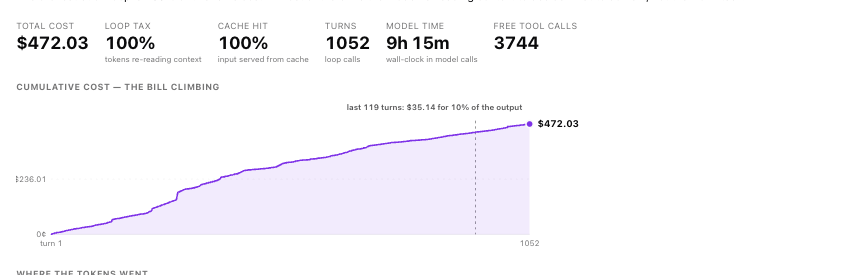
One click from the summary line: the session’s cost curve, turn by turn. The session pictured is a real working stretch — $472.03 at API rates across 1,052 turns and 31h 42m, 100% loop tax: the orchestration loop re-reading 298.9M tokens of context (at a 100% cache hit rate, the only reason it wasn’t several times more). The last 119 turns bought 10% of the output, and all 3,744 tool calls underneath were free. That’s the kind of fact that changes how you use the tool — and which model you point the loop at.
3. The tool surface: everything it could do, before it does
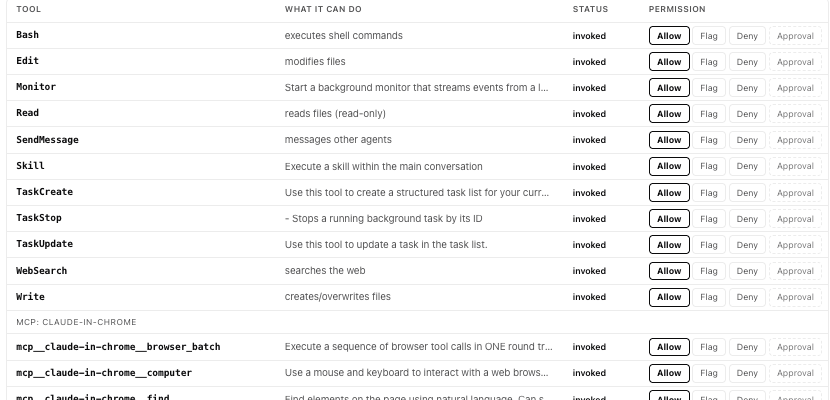
A real Claude Code session declares 76 tools in every request — the coding loop, plus tools that send messages, publish public web pages, schedule their own future runs, and drive your logged-in browser. Sixty-four of them never invoked. ACP captures the declared catalog on the agent’s first call and turns it into a control table: every tool a row, every row a click — allow · flag · deny. Deny blocks at the gateway before execution; the agent gets the reason and adapts.
Which ones should you deny? We argued a default posture from blast radius — and maintain live captures per client.
4. The morning after, in your inbox
ACP · yesterday: $0.28 billed · $148.16 @ API rates · 2 things worth a look

WHAT CHANGED (last 24h)
  codex_exec — NEW AGENT, 17 tools declared:
    + apply_patch, exec_command, image_generation …of 17    [Review →]
A daily digest: spend vs your typical day, the runs worth a look, and every change to your agents’ tool surfaces as a diff — each line a click from the control that fixes it. No activity, no email.
What this costs you
Nothing to start: free up to 5 initiating agents — unlimited calls, subagents free, full identity, policy, audit, and the cost X-ray. Your model spend stays on your own keys and subscriptions, always — ACP never touches or marks up your tokens.
curl -sf https://agenticcontrolplane.com/install.sh | bash
Teams: per-agent policy, roles, org-wide cost, and approval workflows live on the team plan.